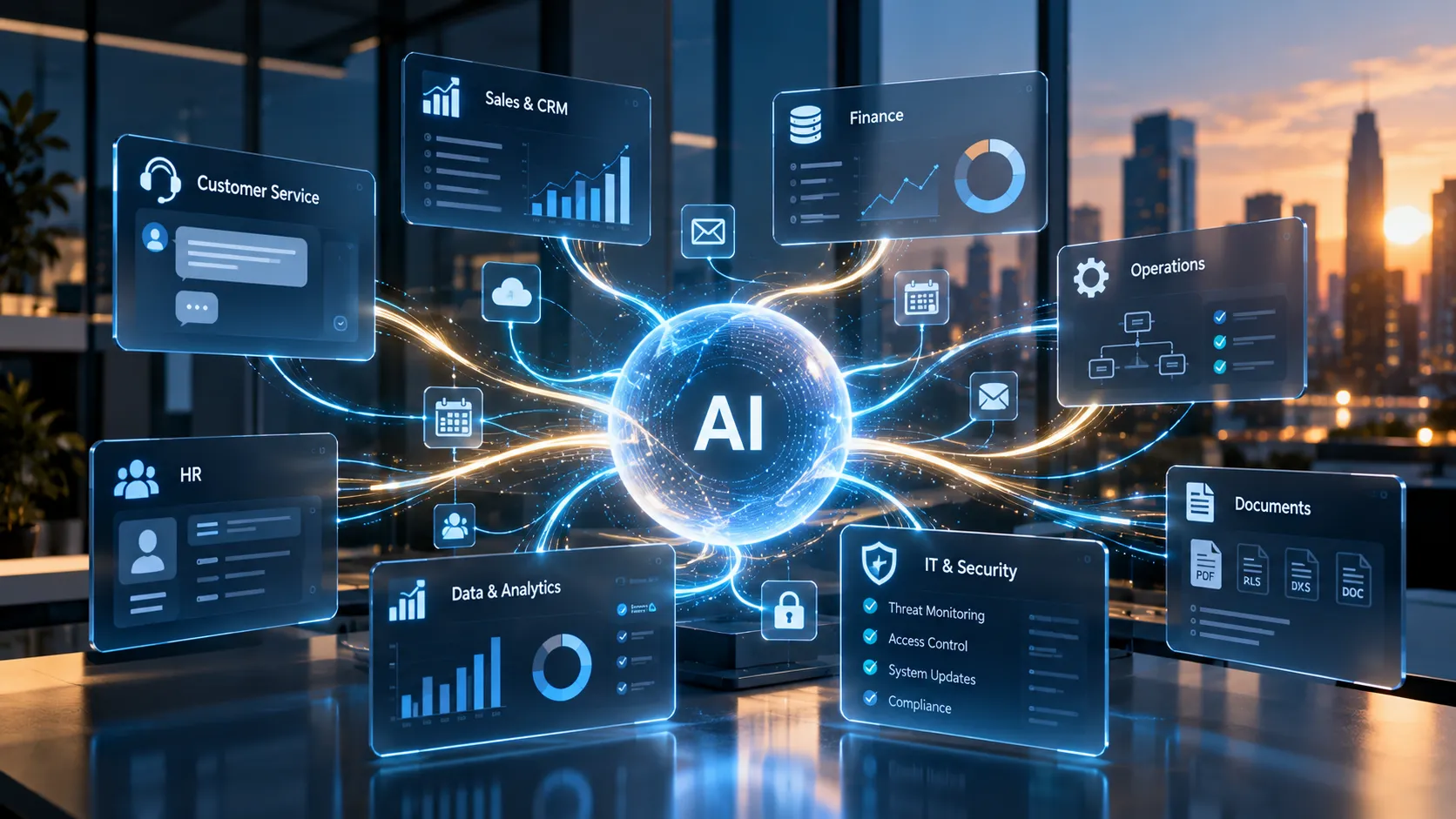

Artificial intelligence is moving beyond tools that simply answer questions or generate content. A new generation of specialized AI agents is being developed to carry out business tasks, interact with software systems, and support increasingly complex workflows.
For companies looking to improve efficiency, these technologies represent an important step forward. Instead of asking an AI assistant to provide information, organizations can use an AI agent to help complete a defined process, from retrieving relevant data to preparing documents, updating records, or coordinating actions across applications.
But the greatest opportunity may not lie in building AI agents that attempt to do everything. It may come from developing specialized systems designed around the needs of particular businesses, departments, and industries.
As enterprise adoption evolves, specialized AI agents are creating opportunities for emerging technology providers and offering businesses new ways to approach automation.
What Are Specialized AI Agents?
An AI agent is a software system that can use artificial intelligence to interpret objectives, determine appropriate steps, and interact with tools or data sources to perform tasks.
Unlike a conventional chatbot, which primarily responds to individual questions, an AI agent may be able to execute a sequence of actions within an established workflow.
For example, a chatbot might explain how to prepare a customer service report. An AI agent connected to authorized business systems could retrieve relevant service records, organize the information, prepare a report, and submit it for employee approval.
The distinction is important because AI agents introduce a more active role for artificial intelligence within business operations.
However, not every AI-powered automation tool is an autonomous agent. Some systems follow predefined rules, while others use AI to select actions dynamically. The degree of autonomy depends on the product, its configuration, and the permissions it receives.
Specialized AI agents focus on particular activities, such as managing customer requests, supporting financial operations, or coordinating internal processes.
Why Businesses Are Interested in AI Agents
Organizations have invested in business software for decades, yet many everyday workflows still require employees to move information between applications, check records manually, and coordinate repetitive activities.
AI agents offer a potential way to reduce some of that friction.
By combining language understanding, access to authorized tools, and workflow automation, agents can assist with tasks that previously required several separate steps.
The business value depends on how effectively these systems solve an existing problem.
For example, an organization might use an AI agent to classify incoming requests, retrieve relevant account information, prepare a response, and direct the case to the appropriate employee.
Another company could use an agent to collect operational information from several systems and produce a preliminary report for management review.
These applications do not necessarily require full autonomy. In many cases, the most practical approach combines automated preparation with human approval for consequential decisions.
1. AI Agents for Customer Service
Customer service is one of the clearest areas where specialized AI agents can provide value.
Businesses receive large volumes of inquiries concerning orders, billing, technical issues, appointments, and product information.
Traditional automated systems can handle simple questions, but more complex requests often require information from multiple applications.
A customer service AI agent may be able to identify the nature of a request, retrieve relevant information from a customer relationship management platform, and suggest the next appropriate action.
For example, an agent could help a support representative investigate a delayed order by checking shipment information, reviewing the customer’s account, and preparing an update.
When properly integrated, this approach can reduce repetitive work and allow employees to focus on cases requiring judgment, empathy, or specialist knowledge.
Nevertheless, companies must establish clear limits. Sensitive account changes, refunds, and other consequential actions may require additional verification or human authorization.
2. AI Agents for Sales and Business Development
Sales teams frequently spend considerable time researching potential customers, updating CRM records, organizing information, and preparing follow-up communications.
Specialized AI agents can assist with these administrative and analytical activities.
Potential applications include organizing publicly available company information, summarizing customer interactions, preparing meeting briefs, and identifying missing details in sales records.
An agent could also help a sales representative review an existing account before a meeting by collecting relevant information from authorized internal sources.
The objective should be to support better-informed sales activity rather than generate large quantities of automated messages without appropriate review.
For technology providers developing sales-focused AI products, integration with existing CRM platforms and reliable handling of customer information are particularly important.
3. AI Agents for Finance and Administration
Finance and administrative departments manage processes that often involve structured information, documents, approvals, and repeated checks.
These characteristics make certain workflows suitable for AI-assisted automation.
For example, an agent might help collect invoice information, compare records, identify discrepancies, and prepare items for an employee to review.
Other applications include expense classification, document organization, financial reporting assistance, and internal request management.
However, financial information requires a high degree of accuracy and control.
AI-generated results can contain errors, and an agent should not be allowed to approve payments, alter critical financial records, or execute sensitive transactions without appropriate authorization.
Successful implementations combine automation with validation procedures, audit trails, and clearly defined responsibilities.
4. AI Agents for IT and Internal Operations
Information technology departments often manage recurring requests involving software access, account administration, technical documentation, and system troubleshooting.
Specialized AI agents can assist by retrieving knowledge-base information, classifying support tickets, collecting diagnostic details, and preparing recommended actions.
An internal IT agent might guide an employee through an approved troubleshooting process or assemble relevant technical information before escalating a problem to a specialist.
More advanced systems may interact with authorized management tools to carry out limited actions under established policies.
This creates opportunities to improve response times, but it also introduces security considerations.
Agents connected to business infrastructure must operate with carefully controlled permissions. Their activities should be logged, monitored, and subject to appropriate approval requirements.
5. Industry-Specific AI Agents
One of the most interesting developments is the emergence of AI agents designed for individual industries.
A general-purpose assistant may understand a wide range of subjects, but an industry-specific solution can be designed around particular terminology, data structures, regulations, and workflows.
Healthcare
AI agents can support appointment administration, clinical documentation workflows, and the organization of healthcare information. Applications involving patient care require careful validation, privacy safeguards, and professional oversight.
Manufacturing
Industrial organizations may use AI agents to help analyze maintenance records, coordinate service requests, or retrieve operational information from connected systems.
Professional Services
Legal, accounting, and consulting firms can use specialized agents to organize research materials, search authorized document collections, and prepare preliminary analyses for expert review.
Logistics
Logistics companies may benefit from agents that help track shipments, organize documentation, identify delivery exceptions, and coordinate information across transport management systems.
For emerging AI companies, this specialization can create a meaningful competitive advantage. A product designed around a clearly defined workflow may be easier for potential customers to evaluate than a broad platform with an unclear business purpose.
How AI Agents Connect Business Systems
The usefulness of an AI agent depends heavily on the information and tools it can access.
Businesses typically operate through multiple software platforms, including CRM systems, enterprise resource planning applications, document repositories, communication tools, and industry-specific databases.
An AI agent may need to interact with several of these systems to complete a task.
Application programming interfaces, integration platforms, and controlled tool connections can provide the technical foundation for these interactions.
However, connecting systems is not simply a technical exercise.
Organizations must determine which information an agent can retrieve, which actions it can perform, and how its results will be checked.
Data quality is another important factor. If an agent relies on incomplete or inconsistent information, its recommendations and actions may be unreliable.
This relationship between enterprise data and AI capabilities is explored in Tech Impact’s interview with Zetaris, which discusses an agentic lakehouse approach to accessing information distributed across business systems.
Watch the conversation in the Tech Impact episodes collection.
Why Specialized AI Startups Have an Opportunity
Large technology companies provide powerful AI models, infrastructure, and development platforms. However, many businesses still need solutions that address specific operational requirements.
This creates space for smaller technology providers.
Specialized AI startups can concentrate on particular workflows, industries, or customer segments, developing products that integrate with the applications businesses already use.
For example, a startup focused on property management could develop an agent that helps coordinate maintenance requests and tenant communications.
Another company might specialize in administrative workflows for healthcare practices or documentation processes for logistics providers.
These focused applications can offer a clearer explanation of business value.
Customers can evaluate whether a product reduces manual work, improves response times, or helps employees complete tasks more consistently.
Nevertheless, smaller providers must demonstrate more than technical innovation. Security, reliability, customer support, integration capabilities, and long-term product development are essential considerations for business buyers.
The Challenges of Deploying AI Agents
Although specialized AI agents offer promising capabilities, organizations should not assume that every workflow is suitable for autonomous execution.
Several challenges deserve particular attention.
Accuracy and Reliability
AI systems can misunderstand instructions, generate incorrect information, or select inappropriate actions.
Businesses need testing procedures, validation mechanisms, and clear rules for handling uncertain results.
Data Privacy
Agents may process confidential business information, employee records, or customer data.
Organizations must understand how information is accessed, processed, retained, and protected.
Identity and Permissions
When an agent interacts with business applications, it requires an appropriate identity and clearly defined authorization.
Giving an agent unnecessary access can increase the consequences of errors or security incidents.
Human Oversight
Organizations should establish which actions can be automated and which require employee approval.
Financial transactions, sensitive account changes, and decisions affecting customers may require additional safeguards.
Monitoring and Accountability
Businesses need visibility into the actions their agents perform, the systems they access, and the outcomes they produce.
Activity logs and review procedures help organizations investigate problems and improve performance.
The U.S. National Institute of Standards and Technology has identified security, identity, and authorization as important areas for the responsible adoption of AI agents.
Learn more through NIST’s AI Agent Standards Initiative.
How Businesses Can Evaluate an AI Agent Solution
Before adopting an AI agent, organizations should identify a specific business problem and determine whether automation is appropriate.
A practical evaluation can begin with several questions:
- Business objective: What problem will the agent solve?
- Workflow: Which steps can be automated, and which require human review?
- Integration: Can the solution connect securely with existing applications?
- Data access: What information does the agent need to complete its tasks?
- Permissions: Which actions is the agent authorized to perform?
- Performance: How will the organization measure accuracy, efficiency, and business value?
- Security: How are sensitive information and system access protected?
- Vendor support: Can the provider maintain and improve the solution as requirements change?
A limited pilot project can help companies assess these factors before expanding an implementation.
Businesses should also compare AI agents with conventional workflow automation. If a process follows predictable rules and requires little interpretation, a simpler automation solution may be more reliable and cost-effective.
The Future of Specialized AI Agents
AI agents are likely to become an increasingly visible part of business software, but their long-term value will depend on how effectively they support real operational needs.
Rather than replacing entire departments, many practical applications will focus on specific tasks, assisting employees and coordinating work across existing systems.
For emerging technology companies, this creates an opportunity to develop focused solutions with measurable benefits.
For business leaders, the challenge is to identify where AI-driven automation can improve performance while maintaining appropriate control over information, decisions, and system access.
The next stage of enterprise AI will not be defined only by more capable models. It will also depend on reliable integration, effective governance, and products designed around the way businesses actually operate.
AI Impact, a special edition from the producers of Tech Impact, explores the technologies, companies, and innovators turning artificial intelligence into practical business applications.
Discover more conversations with technology leaders in our episodes and interviews.